Why Increasing Prices of Items Is Dangerous During Coronavirus Crisis

Coronavirus has created helpless situation for many in the United States. Doctors don't yet have a definite treatment for Covid-19. People are panicking about both Covid-19 and shelter-in-place for which they are buying essential items in bulk. If you are a business wanting to take advantage of this by increasing their prices think twice. It is highly dangerous right now.

Under the scanner of consumers, journalists and states:
  • Brick-and-mortar stores
  • Online stores including marketplaces
  • Third party sellers
Price Gouging Penalties and Evolution

Right now if you raise prices of certain essential items you may get hit by penalties. When emergency is declared or some kind of disaster takes place your such act is considered price gouging and that falls under unfair or deceptive trade practices. If you are caught you may attract civil and criminal penalities.

As of now, atleast 16 states have no anti price gouging law. In some states, it is applied to only petroleum-related business. Rest of the states do not follow one single law, but there seems to be an evolution taking place in how and who will crack it down.

Consider the screenshots below. They provide all the answers. Texas does have anti price gouging law and still their attorney general wants to aggressively prosecute those who break it. States are irritated as they get more complaints about the deceptive practice from consumers. Ohio may soon enact anti price gouging law. Colorado is not doing the same, but they will still go after the culprits. New York does have one, yet their governor is telling federal government to step in.
How does the crackdown look?
Brick and mortar stores may get a visit from cops followed by a slape of fine as shown below by mayor of Jersey City.The store here was fined $90,000 in a single day.
Attorney General of New York talks here about sending hundreds of cease and desist letters to sellers.

What Are the Disadvantages of Getting Committees?

Committees are not without their inherent problems as members are taken from several departments. Each of the people come with his/her own peculiar challenges. In short, committees have certain disadvantages. Some are listed below:

High cost: 

Committees may need a wide range of investigation reports to study the problem they are focusing on. Unfortunately, this investigation can be expensive because of the tools and manpower required to perform it. In some cases, selecting the committee member can require strict background check which can result in more spending.

Delay in decision making process:

Committees are notorious for taking too much time to come up with decisions. This can be because of the differences in views of members connected to their professional backgrounds or need for additional investigation on the problem they are to solve.  The end result of this is not having an agreement, delaying the decision.

Abuse of authority or position:

The democratic elements expected from the committee can be lost when individual committee members begin to push recommendations or outcomes to serve specific special interests.  For instance, in 1986, scholars, Michaels and Oliver asserted in Human Rights Consultation: A 12-Year Experience of a Pediatric Bioethics Committee that survey report connected to Children's Hospital of Pittsburgh showed that its Human Rights committee occasionally established recommendations on ethical dilemmas pertaining to patients to appease the interest of either their physician colleagues or the hospital (pg.571). This simple explanation reveals that the members were well aware of how they could use their position to justify what suited the hospital. The recommendations they provided using it is a depiction of abuse of the position they were given, endangering the lives of the patients.

Reference

Michaels, R. H., & Oliver Jr., T. K. (1986). Human Rights Consultation: A 12-Year Experience of a Pediatric Bioethics Committee. Pediatrics, 78(4), 566-572.

What are the Advantages of Getting Committees?

Just like most groups, a committee consists of individuals. But traditionally, committee members are appointed by an organization because of their differing views and experiences which are expected to be utilized to perform specific functions.

Of course, these functions are predetermined by the organization, but the outcomes are likely to be unique and expected to be neutral and fair. Perhaps, this is the main reason why committees are built. But they definitely come with advantages as shown below:

Professional development and acquisition of leadership skills: 

Committee is a veritable forum for training and educating future and aspiring managers and supervisors. Working with the skilled members coming from a wide variety of professions help them widen their views and open to new possibilities. And when they are able to prove themselves as good decision makers they manage to send the signal to their employers of their potentials in leadership position. In brief, by serving within committees, the employees can learn and develop the ability to objectively and critically analyze, and solve organizational problems which later gives them the chance to climb the corporate ladder.

Facilitation of coordination: 

Participation in committee activities or meetings promotes mutual understanding between high brass administrators and their employees. In fact, committee meetings can be taken as an important tool supervisors can use to coordinate the activities of the organization because such meetings draw together employees and managers from different departments.  However, effective coordination via committee meetings requires the presence of important stakeholders. For example in a hospital where a health committee is established, such coordination according to a circular from British medical journal cannot be achieved unless the committee includes proper representation of the medical professionals from the relevant areas or fields.

Pooling of knowledge and experience: 

Since members for the committee are chosen from various departments, it becomes easy to see the problem they are working on from multi lenses. The recommendations they generate can have similar effect because of the diverse knowledge and experiences establishing how they would influence the different departments of the organization. This to us is a sign of enhanced decision-making process.


Liaison body:

At some point in an organization where decision made is likely to affect some group of employees, the company committee can stand in the gap as a mediator between the company and the employees to overcome pressure, resistance or actions that is capable of putting both the management and employees at loggerhead. For example in a company planning to lay-off some staff, the committee can help assuage any unpleasant reactions from the affected employees.

Improved employees morale and motivation:

Having representatives for employees in a committee serves as a morale booster and also helps  create in them a sense of belonging. Employees are eager to execute decisions made by an organization when they have participated actively in the decision making process.

Levels of Strategic Management

Let’s remind ourselves that the basic meaning of corporation is large company. How does it stay alive? By using strategic management consisting of levels as explained below.

Corporate level:
Corporate level strategies are associated with going beyond the established business of the corporation. They can be broad and completely dissimilar to what already is in place.

The objectives of these strategies can be related to:
- Cost effectiveness/return on investment
- Gaining or maintaining market share
- Looking for new markets
- System integration solutions

Corporate level strategies help a business stay competitive, make more money and defend itself from any industry level future crisis occurring as a result of recession, deprecated system or change in regulations.

Divisional level:
Divisional level strategies focus on specific businesses being done by the corporation. To put it another way, each business may have one dedicated entity going by the name of strategic business or strategic service unit to come up with the strategies which may include arranging new division for a chosen new market and making the existing division more efficient so it can stand out against its rivals in a specific market.

Divisional level can be taken as necessary because on the top, people may not have full knowledge and time needed to arrange a division.

Organizational level:
A division consists of multiple organizations. Their services need to flow in a way to make a division run smoothly and compete against rivals. How to do it is what organizational level strategies focus on. Do notice the word service used earlier. What this signals is that organizational level strategies are made for services already set through divisional level strategies.

Unit level:
An organization can have multiple units different from each other, but their collaboration brings in efficiency. It is not possible without what we can call as unit level strategies. To understand it better think about an organization in engineering field. One unit has engineers. Then there is another that has human resources. They can work together in the same building, but their objectives are not same. Human resources unit does not do engineering work. They focus on engineering unit’s salary, benefits, number of people needed, implementation of rules and regulations. This is made possible through unit level strategies and they are based on human resources contents. But yes, both the units have one single objective to keep the organization alive because that’s how they keep their own jobs alive as well.
As you can see, the strategy levels are connected to each other from top to bottom. It is not important to have this exact style in place though. One can live without the other, signaling we have the freedom to add or subtract any of them. Much depends on how knotty our corporation is business-wise. In general, the levels can certainly make broad strategies easier to implement.

Three Way Stretch and Location Flexibility: Two Flexible work alternatives to Use in Businesses

What if work schedules spoke the language of emotions? We all have certain things in life which need more of our attention. But work does not let us go to them. This is not true in all cases though. Consider three-way stretch and location flexibility:

Three-way stretch


In this arrangement, employees are given a wide range of schedules to choose from and cross training, but at the same time they are required to do occasional direct site work. This happens to be the core employment rules of retail stores where managers are required to compromise with college going employees because of their unpredictable class schedules and exams. So in a way, these students benefit from it. They are able to have income while completing their degree.

Since malls and fast food places have gone ballistic, three-way stretch is now a tradition all across America. The disadvantage for employees, but good news for the manager is that job hours in such places are based on "peak time" and in many ways can be described as temporary.

If people suddenly decide to stay away from the business due to seasonal issues, one can be told to leave for the day or forever. Those who show extra effort are retained by the retail stores for years, hinting that these employees are being successful.


The disadvantage lies in the fact that three-way stretch flexibility cannot be offered to all employees, for this would compel the human resources department and manager to spend more time in creating schedules.

Location flexibility

Through this, the employee is allowed to work from home. Its another title is remote work. Many organizations such as Facebook, Dell, American Express and Aetna frequently use this arrangement. Small businesses which cannot afford leasing an office space can also find benefit from it. Location flexibility is dream come true for workers who have ride problem or like to stay at home.

Surprisingly, research shows that output from remote work is usually better because the employees give their best through it with the assumption that it is their only way to prove themselves to supervisors not directly overseeing them. But the organizations listed earlier are all tech savvy and this means that those who work through computers can be more successful at remote work. Despite having less money, small businesses do not always have the privilege to utilize the arrangement.

Government itself may limit the thing for them based on industry and typically due to safety concern.  Location flexibility has also gained bad reputation from scammers promising work at home jobs. This controversy makes it difficult for businesses to get their job ads taken seriously by job candidates.

What is Evolutionary Strategic Change?

When the term is broke we get:
Evolutionary: Continues slow progress
Strategic change: Carefully planned move or shift

Definition

The evolutionary strategic change is what happens when new strategic directions come right in front of the eyes of management due to unpredictable things taking place in the environment. The process is rather slow and the strategies come one at a time in an ongoing basis.

It is all about continues modification of the technical sides of the business to make it positively adjust to the changing environment with the intention of helping the main strategy of the organization survive and succeed.In short, it is usually worth the effort.

Fitting management into the picture

Evolutionary strategic change does not occur in vacuum. The management, in point of fact, must attempt it by showing the willingness to learn and recognize the need for change in the strategies of the business operations. To put it another way, the approach requires auditing of those that are already deployed to see if they are going in flow and an openness to a wide variety of ideas coming from the employees because they are the ones responsible for the operations. They all have to work together despite being from different departments. Therefore, there is a need for culture in the organization which fosters the drive for evolutionary strategic change.

Example of Evolutionary Strategic Change

  • Upgrading of equipment to make the performance of workers efficient enough to respond to demands of the market quickly
  • Making use of fresh new technology of the world to reach out to customers
Think about the craze for apps
  • Gradual improvement of customer service
  • Fixing of uneven strategies of the ongoing operations

4 Ways to Make Grapevine Effective

Grapevine refers to a report circulating within an office or company through the mouths of employees. Traditionally, it can be either true or false, but has no official approval from the management.

Managers usually frown upon such reports thinking that employees should only be focusing on their work. They also find it dangerous in certain cases. For instance, a sour grapevine about merger can cause havoc among employees. The misconception make simply force them to not give their best anymore. Moreover, as the oral story moves from person to person, it can have a tendency to pick up more colors than needed. There is truly no way to ban such thing. Employees are just humans and they cannot always act way too formal in their conversation. So instead of trying to control the grapevine, managers should  use it in the best strategic manner. Here are four ways it can be made possible:

Performance improvement: Slipping a grapevine about a specific employee who has been praised by the management for performing well. How he did it should be included in the story. This can help others in the company learn what kind of quality is expected out of their performance.

Survey for decision making: Certain big decisions of employees are connected to the big decisions of their organizations. Fortunately, they don’t usually keep it a secret and this is where grapevine turns into a useful tool. If a manager wishes to know if such scenario may come into existence he has the option to insert possible organizational decisions into the grapevine to see how employees would react to them.
Fill in the blanks: Organization procedures are never without fault. A policy written in the most attentive manner, even after release, can look incomplete, ambiguous and lastly, inapplicable to employees. Grapevine can be used to fill them up with the correct words for clarification purpose.

Enhance Relationships: It is possible to sustain enthusiasm and satisfaction within employees through the grapevine medium. But no, the manager should not participate like a nosy neighbor in this. Instead the bold move should be made to inquire about specific ones in a friendly manner followed by a soft response. Such method would help the employees share a warm relationship with the manager which in turn would improve their ties with the company.

5 Market Research Components

Market research is simply about studying the specifics of a market by collecting data about it. It is helpful in perfecting the product, but also making a fair price for it. For the process to be carried, we need to have the following components:

1. Creating a specific intention for the research:
We can’t open a business or design a product on a whim and expect people to accept it. That is just impractical. People have their own taste which decides whether the creator will succeed. They make up the market, after all. It is highly important to know what they like and then live up to it. This can help the creator even steal a bit of the market share from the competitors. Knowing it all is the intention which must be defined in the first of the market research. This makes the next steps narrow and more organized. Also known as objective or purpose of the study, intention sets up the questions to be answered through the research. 

2. Collection of secondary data: 
Secondary data is defined as the information which already exists. Its first source for a well established business is the internal record. Consumer information can be extracted from it with much ease. For others, business literature and public census given by the government sites can be the major sources. In spite of being economical, secondary data is more likely to be outdated in some cases and because of this, it may not always portray the market accurately. 

3. Collection of primary data: 
Primary data comes directly from the public in the form of their response. For this, the business can decide to go for either surveys or experiments. The survey can be done through mails, internet, person interviews and so forth. The researcher can choose between quantitative and qualitative methods of research. Experiment, on the other hand, mimics lab tests to evaluate the cause and effect points associated with making changes to variables and seeing how potential consumers react to them.
Research instrument: This is the questionnaire to be used to start the process of gathering data. The series of questions to be used must be free of too much broadness as well as bias.  It is also important to include instructions and statements about ethical consideration.


4. Interpretation of the data:
Once the data has been collected it is important to turn them into easy to read information. Doing qualitative research here would reveal themes for the study. Quantitative research which usually provides responses in numeric form can be presented through graphics.  
To make the information easier to read, the researcher can use charts, pies and even tables. Both Excel and SPSS are convenient tools to make it possible. 

Discharge by Performance: Contract

Performance of the parties can trigger a discharge from the contract. This is what we call discharge by performance. This comes in 3 forms:

1. Complete performance: This is quite straightforward. If the performance promised in a contract is fulfilled without a single defect then the people who agreed to it are freed from the contract. Unfortunately, it is not so easy to reach the wholeness. That is why, the second one below is given more priority by the law.
2. Substantial performance: Substantial means sizable. To evaluate whether substantial performance is satisfied a party must show fulfillment of most terms found in the contract. The second thing he must prove is that his attempt to carry it out was genuine. Lastly, he never had any intention to dishonor the contract. Yet if some kind of failure occurs due to not satisfying other requirements stated in the contract the law can compel the sued party to pay money to the plaintiff.    

3. Performance Subject to Satisfaction of a Contracting Party: This is all about satisfactory performance. In other words, a person is discharged from the contract only after he shows that his performance is fully satisfactory. Of course, the other party receiving it judges him. For this, he can choose between subjective and objective evaluation methods.

Discharge by Conditions: Contract

A condition has all the power to discharge a person from a contract. But it does come in 5 different forms:

1. Condition precedent: This condition allows discharging of the party whose contractual duty is supposed to be a response to a specific irregular event, but it just does not come into existence. Basically, there is nothing to perform. Typically, condition precedent forms the backbone of the contract made between a driver and his car insurance company. Accidents are not regular, yet he keeps paying for his car insurance. Eventually, he can discharge the company from the contract by switching to a new one and when he does it in no way he can complain that they did not perform the contractual duty.

2. Condition subsequent: This condition enables discharge based on future events while securing the continuation of the contractual duty from the party before they could happen. The contract between a teacher and his assistant is an example of this. The TA is required to work until his graduation.

3. Condition concurrent: A contract may require both parties agreeing to do something specific for each other at the same time. Condition concurrent helps sue the party failing to carry it out. A good example of this is someone buying a product from a seller. If the seller does not deliver it and has no response about it the buyer has the option to sue him.

4. Express condition: This is similar to a warning. If a party fails to observe it he becomes approved for discharge. Express condition typically contains if-then statements. The demo of this can be found on forums. Think about the posting guidelines. They usually list certain conditions to keep troublemakers at bay.
5. Implied condition: This is an indirectly stated condition. One can even figure it out from the statements found in the contract. Otherwise, it is understood from spoken words. For instance, a woman may complain to her partner about her friends who had cheating partners. She may state that she finds it disgusting and thus, will never tolerate it in her relationships. The partner must translate this as a condition of breaking up. If he cheats she will leave him.

Defining Defects Assigned for Products

Defect in a purchased product is disappointing to customers. Serious concern takes birth from injuries happening because of this. The worst consequence is usually the lawsuit. However, not all defects are treated in the same way. Each has a formal name in the law of products liability. It is important to know them to facilitate improvement and keep away from lawsuits. Defects usually are defined in three ways and they are:

1. Manufacturing defect: This is defined as a defect found in one out of all the similar products coming from a single manufacturer. To understand it better, say all your friends have identical laptops from the same manufacturer. You buy one too. But after taking it out of the box you discover that some of its keys are loose to the point of falling out. This is something not common in the identical ones owned by your friends.

2. Design defect: This is defined as having a defect in the design of all identical products of a manufacturer. For instance, currently, iPhone 6 and 6 Pulses are being in the news for not responding well to touch function. Technicians have said that this is a design defect.

3. Failure to warn: When the manufacturer already knows a defect exists within its products, but do not warn the buyers about it we get the case of failure to warn. For instance, General Motors once sold cars which had defective ignition switches.
They knew about it, but their recalls began after the defect caused somewhere around 124 deaths by suddenly turning off the engines of the cars on the road which unfortunately also stopped the airbags from being deployed. Note that the faulty ignition is still considered a design defect.

Difference between Marketing Executive and Sales Executive

Marketing often is thought to be synonym of selling. Even some job descriptions seem to display this inaccuracy. Certainly, both are driven by the business degree, but their focuses are not the same. If we look at what the executive of each does the differences will become quite visible.

1. When it comes to selling the products a marketing executive is interested in maximizing the profit. Meanwhile, the key responsibility of the sales executive is the quantity to sell mainly to maximize the rewards such as commission.

He may also be required by the company to sell in a way that he hits a specific revenue target.

2. The marketing executive draws plans on how to satisfy the need of the consumer not just through the product, but also information surrounding it. The sales executive's position here is narrow. He becomes one of the segments of the plans by communication the information about the product to make sure the consumer buys it.
marketing

5 Product Levels with Examples

Products can be described in many ways. Similarly, each can have multiple levels satisfying the consumer's needs and wants. For a company also, they are quite beneficial, for they make the product attractive.

Below each one of those levels has been described. We also learn how to identify them from just about any product. Philip Kotler was the one who first theorized them.

1. Core Product
This is the product that adds the fundamental value to the consumer. Think of it as the benefit the consumer is buying. One way to recognize the core product is to ask about the main reason why someone wants it. To understand it, let’s ask why a lady buys a makeup set. The straight answer to it is that she wants to enhance her beauty. So here the core product is actually the enhancement. Someone who has a habit of wearing makeup can see this core product as need. This is what makes this level different from the rest. Its keyword is need. But there are tons of companies offering a wide variety of makeup sets and because of this, consumers now want more than what the core offers.

2. Basic Product
All the ingredients and other items which enable the the product to satisfy the core are together known as the basic product. If asked what is in the makeup kit the basic product would be listed as eye shadow trays, lipsticks, mascara and so on. The ingredients that made them also fall within this level. So to identify this level, just ask what the product is made up of. The keyword here is tangible.
The six items shown in the image form the set. Hence, together they are the basic product.
3. Expected Product
The expected product is the set of features the consumer wishes to have from the bought product. Quality is one of the main examples. In our makeup set case, the color of the eye shadows must have good pigmentation. Everything included must be able to stay on for hours. The consumer can also expect some kind of applicator to be included in the set, for most are now normally sold separately. Therefore, to extract expected product, we have to direct ourselves to the keyword, want.

4. Augmented Product
This can be defined as the product going beyond what the consumer imagines to achieve from the purchase. For a company, this means adding extra features to the product. Such objective tends to be expensive, but the benefits are worthwhile and one of them is praise from customers. Such event significantly contributes to the improvement of the company's reputation, and sometimes customer loyalty. In the market also it can be helpful, for it facilitates product differentiation and achievement of competitive advantage. In some cases, it can trigger the sales to increase. The examples of augmented product for a makeup kit can be a surprise gift, samples, coupon for the next purchase, or adding an extra cosmetic inside not offered by other brands. Online sometimes this is done through the offer of free shipping. So to know what can be taken as augmented product just ask what extras are offered to consumers other than what is needed and wanted by them.
This is example of what the consumer can get by buying the set.
Fun fact: Afidated is utilizing this method. Although you might be here for administration related academic information we offer you things that go beyond it. For instance, we have a "never before seen eslwhere" huge list of transition words to help you make your writings atttractive to your professor. We shamelessly present you tips to help you avoid buying expensive textbooks.

5. Potential Product
This is about the new development of the same product. In this, anything is possible. The next version of it may contain some improvement. Other times, downgrade can pop up. But since potential is included in it we are to expect such elements in the future. This level, thus, is connected to the keyword, change.
Above you can see the levels within the circles. They represent layers. If the examples of the makeup set are arranged within them this is how they would look:
Now if you are asked to identify the 5 product levels from any other example work through it by using the keywords discussed earlier. One of the toughest would be chips. Finding the augmented product from the pack can turn out to be daunting, for most often it might not come with any extras. In a situation like this, look for the price. If it is lower than the original it can be taken as that specific level. 

Difference Between Management and Strategic Management

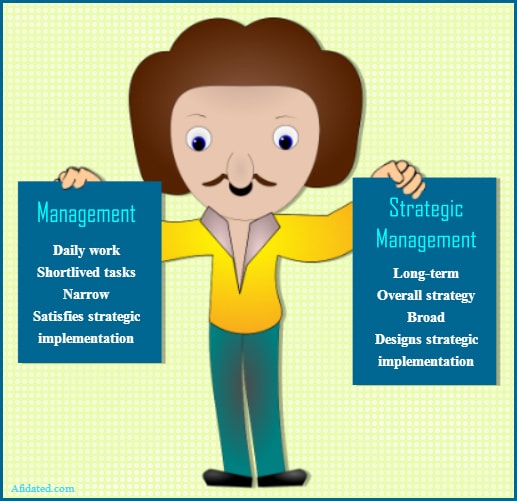
It is often thought that management is just another synonym for strategic management. Truth is that it is a misconception. The two are different things in a business. Strategic management is all about designing the overall strategy for the company. Three elements are attached to it. The first one is strategic analysis which can be defined as doing a systematic analysis of where the company stands. Second one is making strategic choice and this has to do with formulating a course of action. The last one is strategic implementation and this can be defined as technical details on how to put the designed strategy into work.

Management, on the other hand, is the day to day job of the manager. It consists of five functions as stated here. This means that typically, an operation manager is deals with the quality of the production.

Within it, we have buying of raw materials, various kinds of job approvals, machinery, inventory management and much more.

However, the manager of the marketing department is focused on the promotion of the product. Thus, management consists of jobs cut into smaller portions. They fall under tactical planning, a process connected to strategic implementation.
management cartoon
This is how management can be seen different from strategic management,
but the technical elements can't be ignored.
The overall work of strategic management is the responsibility of the top executives of the company. Meanwhile, tactical planning is the responsibility of the managers at mid level and that is also in several forms. As we saw earlier, a company can have both operational and marketing managers. This should hint that the management takes a narrow path. Its counterpart, on the contrary, is all-encompassing. In other words, it takes into account all parts of the business.

Additionally, management decisions are usually short lived and based on general guidelines. But strategic management is continues and its decisions are designed to live for three to five years. Of course, change is permissible simply because of the volatility of the environment.

3 Functions of Organizing to Make Products

Can you start making a product without spending money and knowing whether it will be bought? The answer is yes, but it may simply lead to loss. Hence, in the business world, it is not recommended.
There are actually three functions which are taken as important for success.They can be described as:

1. Marketing: How to know what the people want? The answer to it lies in marketing research. Before making a product, it is important to know whether there is a demand for it. Otherwise, loss may befall.

The marketing research helps understand what the people are missing or want. Marketing can also figure out the concept of the product by evaluating the demand for it.

And when it is created marketing helps promote it. No one will know the product if it is not shown to consumers.
product marketing and accounting
2. Producing: This also goes by the name of operation or production. Producing is what makes the product to satisfy the wants and needs of the people.

3. Accounting: This can also be tagged as financing. No product is made without utilizing some money. Machines need to be bought. Workers are to be hired and given wage for their work. The energy being used up, on the other hand, creates utility bills. Under such circumstances, accounting helps create a budget focused on the production. Once the product is in the market, it helps understand whether it is generating profit or loss.
organizing
As you can see the three functions form a triangle which would go as long as the business is on
Marketing, producing and accounting are actually no more limited to business only. They are being utilized by almost all organizations including those that are nonprofit. Even in politics, they matter. Think about elections. Each presidential candidate focuses on what people want and by using that they do produce promises. To broadcast it, they take the help of marketing as well as accounting. After all, it costs money to advertise.

You may also like:
Many Differences between Goods and Services
Six Categories Of New Products in Marketing
Span of Management With Examples

Many Differences between Goods and Services

In basic sense, we know that services are intangible, hinting they cannot be touched and seen. On the other end of the spectrum, we have goods described as tangible for which they can be touched and seen.

But in the realm of business and society, the difference between services and goods does not end there. In fact, they can be broken down into many other differences. Below some are described.

1. Goods are homogeneous, meaning they are of uniform structure or composition. Services are heterogeneous and that means they are made up of parts that are different from each other.

2. Goods can be sold several times. Think about a house, books or electronic products.

Unless they fall apart or the maker puts a restriction, they can be resold many times. Reselling of service this way is rare. Most often it is impossible. So all services bought tend to be always new.
New Product Fact
3. Supply of goods can be stored in a place. Same is not possible for services.

Span of Management With Examples

The general meaning of the span of management is the number of employees or activities a manager or the company can manage. Scholars sometimes create confusion by titling it as span of control, span of authority and span of supervision. Although the concept itself is thousand years old there has not been any solid agreement about how to interpret it. But it is taken as truth that for the sake of efficiency, there should be a limit to the number of employees or activities a manager should manage, but this is affected by various other factors for which different business concepts have been used to narrowly measure the span of management. Those concepts can be described as:

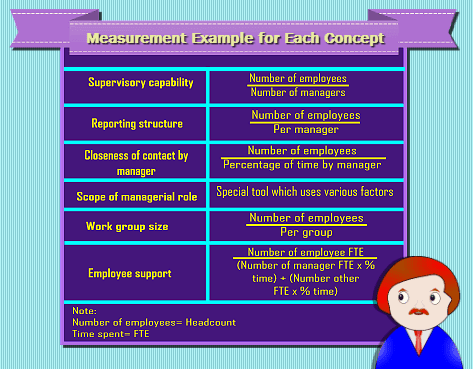
Supervisory ratio: Since this falls under the category of the organization as a whole, it measures the span of control or capability of all supervisors. Its aim is to find out how many supervisors are needed considering the number of employees to be supervised in the organization.

Reporting structure: This goes in the domain of individual manager's job and its task is to calculate the number of people he is responsible for. Within it, lies his power to control, indirectly revealing the limit he has as an authority figure. he measurement of reporting structure  is titled as raw span. Reporting structure can be affected by the different levels of management. Someone on the top will usually have less number of reporters. But the one below can have more, giving rise to the notion of wide span of control. However, do not confuse it with access to the manager.

Closeness of contact by the manager: This is also connected to manager's job. Do note that he does not just manage people, but also performs other tasks. That makes him a busy person. Under such circumstances, closeness of contact by the manager tries to answer the question of how much time he gives to his direct interaction with his employees. This can be affected by the technical experience and skills of the employees. The job of a manager does not always require him to be expert in their fields. This gap pretty much lowers the amount of time of supervision. The opposite makes him interact with them more, creating a narrow span of control. One of the most interesting things about the concept of closeness of contact by the manager is that it can help figure out how much responsible the employees feel in their job. When the manager spends too much time interacting with them their sense of responsibility slides simply because they are under his control. This can make them feel that he is the one responsible for anything they are doing. They do not require to think.

Scope of managerial role: This one measures the range of the manager in his job by taking into account the wide variety of tasks he has to do and their difficulty levels along with managing employees. Typically, surveys can be used to get information for the measurement.

Working group size: Now we move away from manager's domain to his employees. When they are treated as a group we can ask how much of managerial support they have. A group can be either large or small. Similarly, under a manager, there can be several groups. This is where working group size pops in. It simply evaluates the number of groups the manager is responsible for by taking into account the number of employees found in each.

Employee support: Are the employees getting enough management help from all the managers and additional influential employees? Estimated Employee support answers this question. It considers the amount of time given to them. Indirectly, it can reveal how much they are being empowered.
Span of Control
Raw Span Versus Adjusted Span of Control
Notice that most measurements above are based on divisions linked to headcounts. They are known as raw span. But then we have FTE which stands for full time equivalent. When this time is taken into consideration the span is titled as adjusted. Both can be used for measurement, but they are not going to give the same kind of values. Raw span is most favored. 

Major Organizational Structures Explained

The idea of organization structures comes from scientific management. It is a way to systematize work. However, the essential elements which make them so popular lies in the assumptions that the productivity of employees can only be guided by the management. Another assumption is that there can be a best organizational structure which eliminates any supposed problem. Later many other theories followed, giving rise to changes in the views. Organizational structures can be identified in the following ways:

Simple Structure

This is also known as flat organizational structure. Small businesses tend to adopt it. Within the flat structure, employees are not divided, but grouped in one level. This makes the structure somewhat informal, allowing them to have freedom to control some aspects of their work. What they do in their job can vary, but it does not involve specialization.

Meanwhile, all important decisions are taken in centralized manner and the one responsible for it is the business owner himself. They come in quite quickly because he relies on no other boss except himself.  Another reason is the direct communication between him and his employees.

A good example of simple structure is an independent retail store. The store owner is the manager. He takes decisions and may sometimes directly work with the employees. They are all together under the same roof. A lot of multitasking is involved here. While some are on the floor the rest are behind cash register. If given more freedom they can switch the roles.
small business structure

Six Categories Of New Products in Marketing

Managers are usually not required to have technical know how. This means that it is possible to get away without knowing the details of what the employees do. But what about certain important terms given to products? In marketing, they do exist and it would be embarrassing for the manager to not know about them. This is true especially if the company makes products. They have six categories which are very important to understand because they are related to the success of the business. Below we go through the explanation of each.

1. New-to-the-world
What do we call a never before seen product? An invention. Its first setting is the lab. Only its inventor knows how to make it work. The average person on the street is hardly aware of anything about this new product. He needs to be educated about it. This instantly puts the invention under this category called new-to-the-world. It needs to be released with a manual so people know how to benefit from it. When it starts to gain popularity it creates a whole new market of its own.

There are some advantages and disadvantages to focusing on new-to-the-world category. Popularity of the new products can boost the reputation of the company. Additionally, it is possible to protect the designs through patents. In this way, the company can make sure that the business they are getting from the products will not be stolen by potential competitors.
marketing inventions
The disadvantage, however, is that it costs money to research and invent. On the top of that, nothing happens overnight. It can take several months or years for the product to fully form. Yet risk is associated with its release. Sometimes the product is so new that even its inventor has less idea about it. That can mean not being able to foresee glitches. Once released, this faulty product can leave the consumers unsatisfied and angry.

2. New-to-the-firm
How about a product that the company has never made, but is already in the market because other companies are making it? This means that the consumers are aware of how to use it. If the company decides to start making it, its category will be new-to-the-firm. Another marketing term for it is new product line. New-to-the-firm category can be far more relieving than new-to-the-world in the sense that the company does not need to generate knowledge to work on its products. Recruiting experienced and skilled employees for it is easy.
But when it comes to utilizing the new-to-the-firm category, it is always important to choose the product carefully. It must fit the image of what the company produces. Otherwise, disaster may befall. Think about the case of Google Plus. Many of us knew from the very beginning that it was going to bomb because of the potential users' doubt about its connection to Google, the most powerful search engine available today. Very few want their detailed profiles to be overly public and vulnerable to identity theft. Eventually, people thought exactly this way, leaving Google Plus with very less and sometimes dead profiles. 
3. Addition to existing product line
Go back to the first picture above to see the Fone Ring. At this point, it is considered an invention of someone else. What if Apple or Samsung decides to make it by themselves so they can offer it with their smartphones? Under such circumstances, this product would be known as addition to existing product line. The advantage of focusing on this category is that it can bring in some good profits. At this moment, however, most companies do the same through sales of headsets and Bluetooth. They are sold separately. It is a great way to offer convenience. 

That said, one disadvantage associated with this category is that if the main product is already expensive people may choose to get the generic version of such accessories. This can be reverted by locking the main product in such a way that it accepts only the ones made by the main company.

4. Improved and revised
When it comes to offering the best it is important to improve the product for re release. As a company embarks on doing so the marketing department working for them would place it under the category of improved and revised. Think about the cars. The manufacturers tend to modify them for annual re release. Same can be seen in all electronic items such as phones, computers and televisions. The consumers always enjoy some new additions. 
Keeping with such revision can be quite tiring for a company. Huge financial investment is another problem. But if the industry itself has such tradition there is nothing much the company can do. The only thing that can save them is the sophistication of the product. Think about BMW. For many years, its overall shape remained constant. People did not complain about it because they saw it as something that must be owned simply because of its high-end air. 
5. Repositioning 
A company may discover that one of its products already existing in the market has another good usage. To make sure that profit flows from this, they can release it again with such revelation. This would put the product in the category of repositioning. Aspirin is a good example of this. It was first released as a painkiller. But gradually, more of its benefits such as prevention of stroke and heart attack started to pop up. Now the product is known for such usage also. The company itself now has the freedom to market it that way.
The advantage of repositioning a product is that it secures a firm share of the market. Additionally, it attracts new consumers who before did not buy it for its original features. Moreover, researching for such aim is not at all difficult. But very few companies actually take time to focus on this category. One of them happens to be Wet n Wild. It is not taking advantage of the fact that its lipsticks contain the least amount of lead and that is powerful enough to defeat both Estee Lauder and Clinique.
6. Reduction in cost
This category has to do with products that are expensive, but can be made affordable for both the company and consumers. Change in materials or outsourcing the jobs to developing countries is the strategy used for this. Such a turn can certainly bring in more consumers who before could not afford its price. But the main disadvantage is low quality. Cheap materials can force the product to expire quicker. In some cases, it may simply be tough to use.  

Understanding Decision Making Process Steps

Different occurrences will always create some kind of problem in the organization. Usually, it is not difficult for managers to come up with a good solution. But some problems need decisions sensitive to the entire organization. Think about loss occurring as a result of some new features added to the business. How it will be tackled can have a significant amount of negative impact on the company. The worse is bankruptcy. No one wants that. Truth is that to avert a dangerous situation, a decision making process must be used, for it contains elements that can examine the problem and solution better than impulsive thinking. The steps of decision making process given below will help you understand it better:

1. Define the problem

This is a bit complex and time consuming. A problem comes in various shapes. Examples include symptoms, confusions, conflicts, disappearance of something and accidents.  No matter what the problem is, it must be clearly defined. This makes it easy to understand how serious it is. Another advantage of it is that it helps understand when to solve it and for who.  It can also save the managers from getting their reputation ruined.

They are accountable to stakeholders. This means that they must have explanation for why a certain decision has been taken. Clearly written problem can work as support. However, when looking for a technical problem, it is good to involve the subordinates, for they are equipped with technical knowledge, making the task easier and quicker.

2. Analyze the problem

Look for as much information as possible. It is important to get the current data connected to the problem and decide if something is missing in them. There is nothing wrong in searching for additional information. But yes, no data should be taken as trivial despite the fact that anything irrelevant is not required to be collected. Bottom-line is that the manager must look at the information he needs to come up with the decision. Once again, this stage needs help from subordinates. Analysis of problem requires manager to be as objective as possible, yet keep in mind the value of the company and its products or services. Things to focus on must be quality, integrity and reputation. In other words, it is important to weigh the effect on stakeholders. At this stage of decision making process, it is also important to look for contribution from upper management, colleagues and subordinates, for it is impossible for one person to be all knowing and team work is actually far more effective, and empowering.

3. Develop Alternatives

Once the problem has been analyzed, its solutions must be designed in the form of alternatives. It is important to have as many as possible. It is important to involve the subordinates here. Their input can do wonder. Also in a situation like this team effort cannot be ignored. As mentioned earlier, one person is not capable of understanding every aspect of the organization. Consequently, what he develops may end up being unrealistic and rejected by all. Now the best tool to use for development of alternatives is brainstorming. Doing it with all the members can create a discussion powerful enough to understand the pros and cons of each alternative. The other tool is Internet. It can be used to learn how other organizations solve the target problem can bring in enlightenment on what alternatives to create. When the problem is more about consumers, surveys can come in handy. One thing many organizations underestimate is their ideas which if turned into reality can bring in profits.

Last would be expert advice. This can be expensive, but small organizations can actually get it for free by contacting professors working in universities. Many of them love to teach students through hands on experience which actually is not easy to come up with. Not all universities are ready to pay for it. Their main means, therefore, are organizations seeking help. It does not always happen. It is the best kept secret.  Contacting and telling a professor about the problem will allow him to connect the manager or business owner with a class. The students on his behalf would look into the problem and come up with alternatives. In this way, their effort gets them grade and the organization gets alternatives. But yes, it is important to contact the specific department. If the problem is related to human resources, loss of profit or anything product oriented, a business department should be the main choice.

4. Evaluate all solutions to pick the best

When selecting the best alternative budget, effect on subordinates and daily work should always be kept in mind. In other words, the risks should never be ignored. Best option is usually the one which promises economic effort, yet best result. It must be something that gets a yes vote from all the team members. Ethics should not be compromised. It is always good to see if it is legally okay. When it is difficult to select one based on available data and discussion experimenting with each can come in handy. Using a decision making tool available in the form of software can also be helpful. Some of its examples are 1000Minds, MetaTeam, Intelligent Decision System and Decision Lens.

5. Implement the best and follow up

Time to now put the best solution to action. However, work here does not end. The solution should be investigated for its effectiveness. Thus, following up on it is necessary. This should be done through communication and cooperation. The subordinates must be instructed to collect the data on the solution. Cooperation must be encouraged to understand the solution properly. Everyone should have a say on how it is working. Other plans and alternatives designed previously should be preserved for emergency cases such as failure of the best picked solution. At the same time, eyes should remain for changes taking place in external environment. One of the most sensitive elements is technology. It changes too fast, affecting the business. Consequently, despite having the best solution, managers should never give up tactical planning which involves changing with time for efficiency.